










Since 1986, health insurance costs have ranked as the top issue for U.S. small businesses in NFIB surveys. Health benefits can help a small business compete for employees, but choosing the right structure starts with knowing what the business can afford and manage.
An HRA is an employer-funded arrangement that reimburses employees for eligible health expenses under defined rules. We can compare fixed employer contributions, provider networks and administrative work, then weigh group plans, reimbursement arrangements and carrier options.
The best fit depends on workforce size, location and how much cost risk the employer can take on. We’ll compare options by the kind of workforce and trade-offs they suit, not by a one-size-fits-all ranking.
Key Takeaways
- Compare group plans and reimbursement arrangements against your budget.
- Check employee locations and preferred doctors before choosing a network.
- Small teams should confirm local group eligibility and participation rules.
- Compare premiums, employee costs and plan administration together.
- Request quotes using the same employee and coverage details.
Best Health Insurance for Small Business Owners: Top Provider Picks
For broad provider choice, start by comparing the local Blue Cross Blue Shield company; for integrated care, compare Kaiser Permanente where it operates. Local networks matter, since the same insurer can offer different plans and doctors across states.
Carrier and plan availability varies by state. Blue Cross Blue Shield is a federation of 34 regional companies, not one nationwide insurer. J.D. Power’s 2025 Commercial Member Health Plan Study ranked it first in 10 U.S. regions.
Carrier and plan availability varies by state, and regional networks can differ. Compare the local plan, not just the carrier name.
These carrier options suit different business health needs. The table highlights useful starting points, not a universal ranking of insurers or plans.
| Carrier | Strongest fit | Distinguishing plan feature | Availability or trade-off |
|---|---|---|---|
| Blue Cross Blue Shield | Businesses seeking broad provider choice | 34 regional companies offer local networks | J.D. Power ranked it first in 10 regions in 2025 |
| Kaiser Permanente | Teams wanting integrated care | Coverage, hospitals and physician groups work together | Operates in nine states and Washington, D.C. |
| UnitedHealthcare | Employers comparing funding and copay designs | Fully insured, level-funded and Surest plans | Surest uses upfront copays without deductibles or coinsurance |
| Aetna | Businesses that value account options | Offers health savings and flexible spending accounts | Account rules and plan choices vary |
| Cigna | Employers considering cost-control plans | Some plans use narrower provider networks | Check provider access before choosing |
Kaiser Permanente operates in California, Colorado, Georgia, Hawaii, Maryland, Oregon, Virginia, Washington and Washington, D.C. Its own hospitals and physician groups deliver care within its integrated model.
NCQA’s 2026 average plan ratings were 3.5 out of 5 for Blue Cross Blue Shield, 4.6 for Kaiser Permanente, 3.6 for Aetna and 3.1 for Cigna. NCQA’s rating details explain that overall scores combine weighted HEDIS and CAHPS measures, plus accreditation points.
Those ratings are one comparison point, not a full measure of fit. Before requesting a quote, verify the exact local network, plan design and provider directory against your employees’ preferred doctors.
Which health insurance model fits a small business?
An employer wanting one common plan for the team should compare fully insured group coverage first, while an employer wanting to cap its contribution should compare an HRA. The funding model determines who pays claims and how much the employer can budget.
Choose the model based on who carries the risk when claims rise. The main insurance options include fully insured group plans, HRAs, self-funded plans and level-funded plans.
Traditional group plans and their networks
A fully insured plan charges the employer a set premium, and the insurer handles covered claims. This makes monthly costs easier to plan, though renewal premiums can change.
HMO plans generally use narrower provider networks and may require referrals from a primary-care doctor. PPO plans usually offer more provider choice and may cover out-of-network care at a higher cost.
HRAs let employers set a contribution
An individual-coverage HRA, or ICHRA, reimburses qualifying individual health coverage and eligible expenses. Employees choose their own qualifying plans instead of joining one shared group plan.
A qualified small-employer HRA, or QSEHRA, also reimburses eligible expenses, but it has specific size and annual-limit rules. Those rules can shape whether the arrangement suits a small business.
Self-funded, level-funded and direct-care alternatives
With self-funded coverage, the employer pays claims directly and takes on the risk that claims exceed its budget. A smaller business may find that risk hard to predict.
Level-funded plans combine fixed monthly payments with estimated claims and stop-loss protection. Stop-loss protection limits the employer’s exposure above certain claim levels, but it does not erase all risk.
In 2025, 37% of covered workers at firms with 10-199 workers enrolled in level-funded plans. Potential year-end savings are not guaranteed, since actual claims and plan terms affect the result.
Direct primary care is a membership for primary-care services, not insurance. It should not replace comprehensive coverage for hospital care, specialists or other major expenses.
Choose a funding model only after deciding who bears the cost if claims run higher than expected.
How much does small business health insurance cost?
In 2025, the average annual employer-sponsored premium was $9,325 for single coverage and $26,993 for family coverage. Those are annual totals, and small business costs depend on the plan and the people covered.
At firms with 10-199 workers, the average 2025 premium was $9,211 for single coverage and $26,054 for family coverage. A quote depends on location, ages, network, plan design and employer contribution.
| Measure | Single coverage | Family coverage | Population and year |
|---|---|---|---|
| Average employer-sponsored premium | $9,325 annually | $26,993 annually | All covered workers, 2025 |
| Average premium at firms with 10-199 workers | $9,211 annually | $26,054 annually | Firms with 10-199 workers, 2025 |
| Average worker contribution at those firms | $1,440 annually | $8,889 annually | Workers at firms with 10-199 employees, 2025 |
| Average worker premium share | 16% | 26% | Covered workers, 2025 |
| Deductible or cost-sharing note | $1,886 average annual deductible | Not stated for family coverage | Single coverage only, 2025 |
Workers at firms with 10-199 employees contributed an average of $1,440 for single coverage and $8,889 for family coverage. The average worker paid 16% of the single premium and 26% of the family premium.
Employer and employee shares differ widely. At firms with 10-199 workers, 29% of covered workers had employers paying the full single premium, while 29% paid over half the family premium.
A 2026 median projection puts small-group premium increases at 11%, based on filings from 318 insurers across all 50 states and Washington, D.C. That is a median projection, not a guaranteed increase for each business.
Budget for both the premium contribution and the deductible exposure employees may face.
What changes when you have fewer than 10 employees?
A very small team should check group-plan eligibility and participation rules before spending time comparing carrier quotes. Local rules matter, because states and insurers can set different small-group standards.
Some small-group plans require as many as 70% of eligible employees to participate. A JPMorganChase analysis found that businesses with under 10 employees had the highest premiums of any business size.

For health insurance for a small business with fewer than 10 employees, compare a group plan’s participation and paperwork with an HRA. SHOP and individual Marketplace coverage are distinct routes for a very small workforce.
- Owner alone: check whether the owner qualifies for small-group coverage under local rules.
- Owner plus one employee: compare individual Marketplace coverage with any eligible group option.
- Owner plus two employees: confirm who counts as eligible and whether participation rules are met.
For a business with one employee, local rules may decide whether the owner and employee qualify as a group. With two employees, confirm each person’s eligibility before counting the team.
An owner’s legal and tax classification can affect eligibility. It can also change whether the owner counts as an employee for a group plan.
Ask an insurer or licensed broker to confirm the state-specific minimum group size and participation test in writing.
Can business owners get coverage through an LLC?
An LLC owner with no employees can buy individual health coverage, but the tax treatment of premiums depends on how the LLC is taxed and whether the owner qualifies for the self-employed deduction. Owner-only businesses should not assume they qualify for a group plan.
Eligibility depends on tax status, net income and access to other employer coverage. The LLC’s tax treatment affects how premiums are handled, so the same business structure can lead to different tax results.
Owners with no employees
Owners without employees can compare individual Marketplace plans based on location, doctors and expected care. An LLC may pay premiums, but a payment by the business does not automatically make the cost deductible.
Some LLC owners report business income differently from others. That tax classification can affect how the owner handles health premiums and whether the self-employed deduction applies.
Self-employed deductions and Marketplace coverage
For 2026, eligible self-employed people may deduct 100% of premiums paid on Schedule 1 of Form 1040. The deduction reduces adjusted gross income, but the deduction cannot exceed net income from the relevant self-employment business.
The deduction is unavailable for months when the owner qualifies for coverage through a spouse’s employer or another employer. This rule applies even when the owner chooses not to enroll in that coverage.
Self-employed premium tax credits require a plan purchased through the Marketplace. Eligibility for those credits depends on the owner’s situation and Marketplace rules.
Whether an LLC can write off premiums depends on its tax classification and the owner’s eligibility, so the owner should confirm treatment with a tax professional. Check the owner’s tax classification and eligibility for other employer coverage before treating premiums as deductible.
When does SHOP or California’s small-business marketplace fit?
A California employer wanting a group plan should compare Covered California for Small Business, while an owner shopping for personal coverage should compare the individual Marketplace separately. The two routes have different rules for employer tax credits and personal financial help.
For 2026, eligible small employers in most states can use SHOP with 50 or fewer full-time-equivalent employees. Employers with fewer than 50 FTEs are not federally required to offer health insurance.
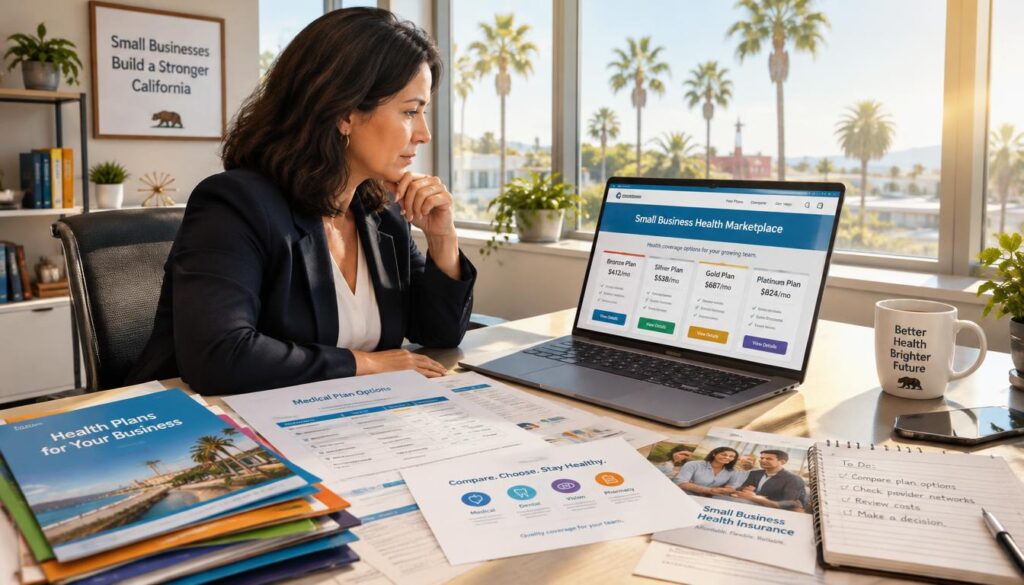
SHOP coverage and federal tax-credit basics
SHOP plans must cover essential health benefits and meet minimum value. Minimum value means a plan pays at least 60% of expected allowed benefit costs for a standard group of people.
SHOP offers Bronze, Silver, Gold and Platinum tiers. Employers may offer one tier or, in many states, more than one tier.
Employees who buy coverage through SHOP do not receive federal subsidy assistance for that coverage. Eligible employers may qualify for a separate federal small-business tax credit.
Covered California for Small Business
Covered California for Small Business offers plans from Blue Shield of California, Kaiser Permanente, Sharp Health Plan and Western Health Advantage. Sharp mainly serves San Diego, while Western Health Advantage serves Northern California counties.
Employers can choose Bronze, Silver, Gold and Platinum tiers. Employers offering two or three tiers must select adjacent tiers.
Eligible California small businesses may qualify in 2026 for a federal tax credit of up to 50% of premium contributions. Eligibility depends on business size, average wages and employer contributions.
| Coverage route | Who it serves | Available tiers or plan details | Financial-help condition |
|---|---|---|---|
| SHOP | Eligible small employers in most states | Bronze, Silver, Gold or Platinum | Employees get no federal subsidy for SHOP coverage |
| Covered California for Small Business | Eligible California employers | Four tiers; two or three must be adjacent | Some employers may qualify for a tax credit up to 50% |
| Individual Covered California | People buying their own coverage | Bronze and catastrophic plans are HSA-eligible HDHPs in 2026 | Some enrollees may still qualify for financial help |
Enhanced premium tax credits ended December 31, 2025, but financial help remains for some Covered California enrollees. Some plans may cost as little as $10 per month, depending on plan choice and income.
From January 1, 2026, Covered California Bronze and minimum-coverage catastrophic plans qualify as HSA-eligible high-deductible health plans. Confirm eligibility, employee contributions and current plan availability before relying on a tax credit or advertised low monthly price.
How do ICHRA and QSEHRA reimbursements work?
An ICHRA suits employers who want to set their own reimbursement budget, while a QSEHRA is limited to qualifying smaller employers that do not offer a group plan. Employees choose qualifying individual coverage under these employer-funded arrangements.
An ICHRA has no federal contribution cap, while a QSEHRA has annual maximums. The right option depends on employer size, employee classes and the plan the business already offers.
ICHRA offers flexible employer allowances
An individual-coverage HRA lets an employer set an allowance for qualifying individual health coverage and eligible expenses. Employees choose their own plans and submit eligible costs for reimbursement.
Employers of any size can offer an ICHRA. They can set different allowance amounts for permitted employee classes, which may help businesses with varied workforces.
The employer chooses the allowance rather than paying a shared plan premium. Employees need qualifying coverage to receive reimbursements under the arrangement.
QSEHRA has size and contribution limits
A QSEHRA is available to employers with fewer than 50 full-time-equivalent employees that do not offer a traditional group health plan. Employers must offer it on equal terms to eligible full-time W-2 employees.
Employees need minimum essential coverage to receive QSEHRA reimbursements. For 2026, the maximum is $6,450 per year for self-only coverage and $13,100 for family coverage.
Those limits equal $537.50 monthly for self-only coverage and $1,091.66 for family coverage. The 2026 maximum amounts are caps, not an automatic employer allowance.
A May hire with self-only coverage has eight eligible months in 2026. The prorated maximum for that employee is $4,300, not the full-year cap.
Employers can set a lower allowance than the annual maximum. Set the allowance only after confirming which arrangement the employer qualifies to offer and which employees can participate.
How can we estimate costs and compare health insurance pools?
For a one-employee business, compare the net Marketplace premium with an eligible group-plan quote before deciding which is cheapest. Use the same inputs, since different employee and plan details can make a cost comparison misleading.
A reliable estimate needs location, covered employee count, ages, plan design, network and employer contribution. A small-business health insurance cost calculator can compare scenarios only when those details match.
Build a useful cost estimate
An individual Marketplace plan may be the lowest-cost starting point for one employee when financial help is available. A group plan may cost less in some areas, depending on eligibility, benefits and employer contributions.
To compare the cheapest health insurance for a small business with one employee, look beyond the premium. The deductible, provider network and out-of-pocket costs can change the real price.
- Enter the business location and number of covered people.
- Use the same ages and coverage levels for each estimate.
- Compare premiums and employer contributions side by side.
- Compare deductibles, provider networks and out-of-pocket exposure.
Keep the calculator inputs and coverage assumptions identical when comparing two quotes.
Check what an association pool actually offers
Trade or professional associations and chambers of commerce may arrange Association Health Plans. A risk pool is a group of covered people whose claims costs are shared.
Pooling can spread claims across participating people, but it does not guarantee lower premiums. Check who can join, what the coverage includes, any fees and how renewal terms work.
Ask whether the pool covers the employees’ locations and preferred providers. Compare its full terms with a group plan or individual Marketplace option before choosing.
What should we check before choosing a plan?
Before choosing, check whether the plan’s network and cost-sharing work for the people who will actually use it. Doctors and costs can matter more than a familiar insurer name.
Compare the premium with employee contributions, deductibles and network access. A plan that looks affordable to the employer may leave employees with costs they cannot manage.
Check the plan against the people who will use it: their doctors, locations, medicines and share of the costs.
- Confirm employees’ doctors and hospitals are in the plan’s network.
- Compare premiums with deductibles and employee contributions.
- Check that the plan fits employee locations and coverage needs.
- Confirm compliance duties and who handles enrollment.
- Assess ongoing administration and wellness or health risk programs.
In 2025, 56% of small firms offering health benefits provided at least one wellness program. Thirty-five percent offered workers a health risk assessment.
A professional employer organization can bundle benefits administration with broader HR support. Direct primary care is an optional primary-care membership, not insurance or a replacement for comprehensive coverage.
Health-sharing arrangements also differ from comprehensive health insurance. Ask employees which providers and medications they need covered before signing the final plan documents.
Conclusion
The strongest choice is the one your business can sustain and your employees can use. Compare local networks and total employee costs, then confirm eligibility before choosing a group plan or reimbursement arrangement.
Request comparable quotes or plan illustrations using the same employee and coverage assumptions. Gather your employee count, locations and target contribution, then request like-for-like options from a licensed broker or the relevant marketplace.