










A plan can make routine checkups and unexpected dental work easier to budget for, but its value depends on the care you need and the rules attached to the benefits. Dental insurance plans can help pay for routine and restorative care, including cleanings and fillings. The annual maximum is the most a dental plan will pay toward covered care during a plan year.
Premiums, deductibles, coinsurance, networks, and exclusions all affect what you pay. A plan may cover a service but still leave you with costs because of a deductible, a share of the bill, or a limit. Individual oral-care needs matter, too: someone who expects a crown may weigh benefits differently from someone who mainly needs checkups.
We can compare these details to judge whether a plan fits the care we expect and the dentists we want to see. A useful comparison starts with your likely treatment needs, not just the monthly premium.
Key Takeaways
- Compare expected care with premiums and out-of-pocket costs.
- Check dentist networks and the plan’s annual maximum.
- Review deductibles, coinsurance, service limits, and exclusions.
- Confirm that a preferred dentist accepts the plan.
- Read the policy details before enrolling.
How Dental Insurance Plans for Individuals Work
Most individual shoppers choose between a PPO that offers more dentist choice and a DHMO-type plan that trades flexibility for fixed in-network copayments. Network rules shape where members can get care and how much they pay. PPO plans have an annual maximum, while HMO plans have no annual maximum and require network dentists.
A dental PPO usually lets members see any licensed dentist, but using an in-network dentist often brings lower fees. A DHMO-type plan generally requires members to choose a network general dentist and pay set copayments for covered services. Check each plan’s rules, since benefits and access differ.
PPO plans have an annual maximum, while HMO plans have no annual maximum and require network dentists.
Dental savings plans are different: they offer negotiated discounts instead of insurance reimbursement. Members pay the dentist directly at the reduced fee. These plans do not work like insurance plans with a premium, covered claims, and an insurer-paid share.
Private individual dental insurance can be bought directly from an insurance company. Marketplace dental coverage cannot be bought by itself there; shoppers must buy a health plan at the same time. Marketplace health plans must make dental coverage available to children age 18 and younger, but buying it is optional. Adult dental coverage is not an essential health benefit, so health plans do not have to offer it.
People looking for full coverage dental insurance plans for individuals should check what “full” means in each policy. It does not mean every service has no cost. Family dental insurance plans can cover dependents under one policy, with eligibility and benefits set by that policy.
Here is a quick comparison of how common arrangements work:
| Plan type | Dentist access | How members pay | Annual maximum or waiting-period feature |
|---|---|---|---|
| PPO | Any licensed dentist; network saves more | Deductible and coinsurance | Annual maximum; waits may apply |
| DHMO-type plan | Selected network dentists | Set copayments | No annual maximum; waits depend on plan |
| Dental savings plan | Participating dentists | Discounted fee paid to dentist | No annual maximum or waiting period |
Before enrolling through the Marketplace, check whether you are buying a health plan at the same time.
Which Individual Dental Plan Fits Your Needs?
A PPO is a practical starting point for shoppers who want dentist choice, while a DHMO-type plan can suit someone willing to use a selected network dentist for set copayments. Start with access, then compare benefits and costs. The best dental insurance plans for individuals depend on the care and dentist access each shopper needs.
Named plans can help show how benefits differ, but no one option fits every person. State availability and policy terms also affect what members can use.

Cigna Dental 1500
Cigna Dental 1500 lists a national-average sample premium of $39 per month for one person, based on rates as of October 2025. It is a sample, not a guaranteed personal rate; premiums vary by geographic area.
The plan provides $1,500 in benefits that can apply toward minor and major procedures, including fillings, crowns, and root canals. Its annual deductible is $50 for one person or $150 for a family for basic and major restorative services.
Routine checkups, cleanings, and routine X-rays are listed at $0, subject to coverage limits and frequency rules. Orthodontia has a $1,000 lifetime maximum. Cigna Dental individual plans should be judged by the full policy, not the sample rate alone.
Delta Dental PPO and DeltaCare USA
Delta Dental PPO Basic has a $1,000 annual maximum per person, a $50 individual deductible, and a $150 family deductible. Preventive services have 100% coverage with no wait or deductible. Basic services have 50% coverage after state-dependent waits; the plan excludes major services, implants, dentures, and orthodontics.
Delta Dental PPO Premium has a $2,000 annual maximum per person, with the same deductibles. It covers preventive services at 100%, basic services at 80%, and major services, implants, and dentures at 50%, subject to state-dependent waiting periods.
Delta PPO plans are available in Alabama, California, Delaware, Florida, Georgia, Louisiana, Maryland, Mississippi, Montana, Nevada, New York, Pennsylvania, Texas, Utah, West Virginia, and Washington, D.C. Enrollment is year-round where a plan is available. PPO members can visit any licensed dentist, with greater savings in the PPO network. DeltaCare USA requires a selected network general dentist and uses copayments.
Humana Complete Dental and UnitedHealthcare
Humana Complete Dental covers preventive services at 100%, basic services at 80%, and major services at 50%, subject to plan limits. Its deductible is $50 for one person or $150 for a family, waived for in-network preventive services.
The Humana annual maximum is $1,250 in year one and $1,500 in year two and later. UnitedHealthcare dental insurance plans underwritten by Golden Rule Insurance Company are PPO plans, but their specific prices and benefits depend on the policy.
Confirm that the named plan is sold in your state before comparing its final policy details.
When Does Coverage Start, and What Can Wait?
Preventive services often start right away, but basic and major work commonly has a waiting period after enrollment. Service type matters: checkups may be available before fillings or crowns. Basic care commonly waits 3-6 months, while major care commonly waits 6-12 months.
These are common ranges, not a promise for every policy. State rules and plan terms can change the wait. “Full coverage” does not mean every service is paid at 100%, or that waiting periods and limits disappear.
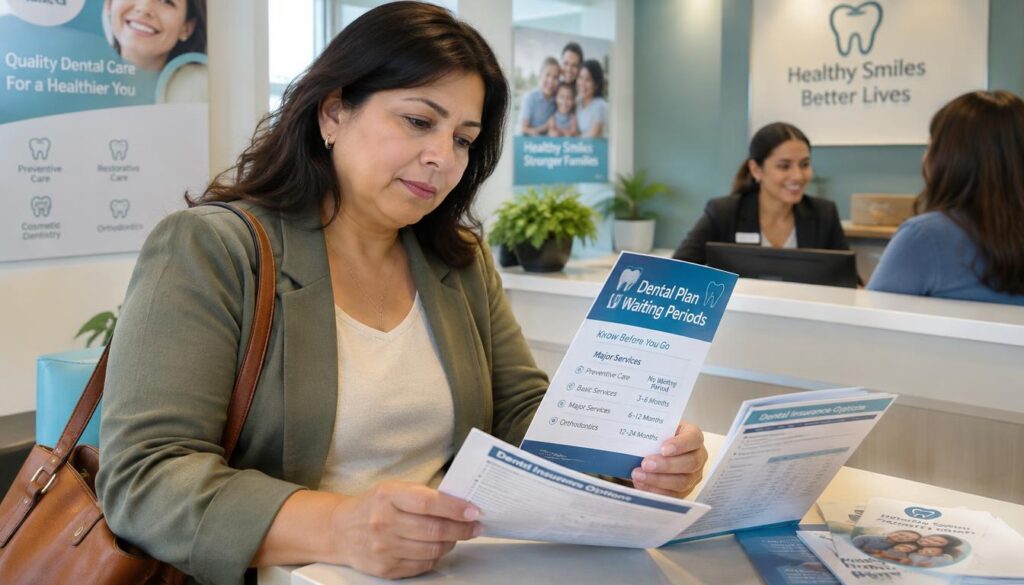
| Service category | Common waiting-period range | Plan-specific exception or example |
|---|---|---|
| Preventive | Often none | Delta PPO and Humana Complete Dental have no preventive wait |
| Basic | Commonly 3-6 months | Humana has a 6-month wait, except in Tennessee |
| Major | Commonly 6-12 months | Humana has a 12-month wait, except in Tennessee |
Some insurers may reduce a wait after prior coverage, but their rules vary. A 12-month stretch of continuous dental coverage is a common basis for a waiver. The old plan may need to include major services, and gaps between plans can affect eligibility.
Before relying on a waiver, check these four details:
- How long coverage must continue without a break.
- Whether the prior plan covered major services.
- How many days may pass between plans.
- Whether orthodontia or implants are excluded.
Cigna Dental Insurance plans can have waits for specific services. Cigna may waive Class 2 and Class 3 waits after at least 12 months of prior coverage that included Class 3 major restorative services, with no more than 63 days between plans. That waiver does not apply to orthodontia or implant waits.
Humana has no preventive wait, a 6-month basic-service wait, and a 12-month major-service wait, except that basic and major waits do not apply in Tennessee. It may waive basic waits after 12 continuous months of prior comprehensive coverage and major waits after 12 continuous months of prior coverage. UnitedHealthcare says some plans have 4-12-month waits for basic and major services.
Delta PPO preventive services have no wait, while basic and major waits vary by state. DeltaCare USA has no waiting periods. Orthodontia waits often last 12 months or longer, and orthodontia commonly has a separate lifetime maximum.
Read the policy’s state-specific waiting-period language before scheduling treatment around a waiver.
How Can We Compare Costs and Choose a Plan?
The lowest premium is not automatically the cheapest choice once deductibles, coinsurance, and annual limits are added. Expected treatment helps show the real cost. Compare the premium, deductible, coinsurance, annual maximum, and network fees against the care you expect.
Cheap dental insurance plans for individuals may have lower premiums but trade away dentist choice, first-year benefits, or major-service coverage. A contracted network fee can lower the price of care, but only if the preferred dentist participates.
Start with the care you expect
List likely procedures, such as cleanings, fillings, or a crown. Then compare the plan’s share of each bill with its premium and deductible. Cost estimates are not guaranteed payments. Geography, treatment details, provider charges, and plan benefits can change the final amount; geographic estimates may use the first three ZIP code digits.
Check the dentist network and cost sharing
A PPO may let members visit any licensed dentist, but network dentists often charge contracted fees. Check whether the dentist accepts the specific plan, not just the insurer’s name. Also review coinsurance, which is the part of a covered bill the member pays.
A plan covering major work at 50% with a $1,500 annual maximum would pay $1,500 toward a $9,000 treatment plan. The annual maximum can run out before extensive care is fully paid. For a $1,369 crown, a plan with 50% major coverage and a $1,500 annual maximum would pay roughly $685. A 20% dental savings-plan discount would save $274 instead.
Compare the year-one ceiling
Plans in a 2026 comparison have typical annual maximums of $1,000-$2,500. A high limit can help with major care, but it does not guarantee payment for every procedure. Check these details together before choosing:
- Expected procedures and their timing.
- Your in-network dentist and the fee for each service.
- Waiting periods and coinsurance for those services.
- Annual maximum, exclusions, and any missing-tooth clause.
Some policies exclude replacement of teeth already missing when coverage began, and that exclusion does not expire. Ask the dentist to confirm estimates, then use policy documents to check coverage, limits, preauthorizations, or referrals.
Check for a missing-tooth clause if replacing a tooth that was already absent before coverage began.
What If You Need Dental Care Without Much to Spend?
If a dental bill feels out of reach, ask a community health center or dental school clinic about lower-cost care and available payment arrangements. Local options can help people find a way to address urgent needs. State-specific Medicaid adult dental benefits vary, and eligibility does not guarantee free treatment.
Community health centers may offer dental care based on income and local services. Dental school clinics provide care from students under supervision, sometimes at reduced rates. Travel and longer waits can be trade-offs, so ask what treatments the clinic offers and when appointments are available.
A dental savings plan can provide discounted fees right away, with no waiting period or annual maximum. It does not reimburse bills; the member pays the provider at the discounted rate. Check that a nearby dentist participates and that the discount applies to the needed service.
Tooth replacement costs depend on the treatment and the number of teeth involved. Dentures often cost less upfront than implants, but there is no cheapest choice for everyone. Implant suitability and the full treatment plan can change the total cost.
One dental implant with all components typically costs $3,000-$6,000 in the United States, with a national average near $4,400. All-on-4 treatment typically costs $15,000-$25,000 per arch in the United States. Some dental school clinics offer supervised implant care at reduced rates, with travel and wait time as possible trade-offs.
A dental savings plan lowers the provider’s fee, but the member still pays the dentist directly.
Ask about payment arrangements before treatment begins, and make sure the estimate includes each planned step. Get a dentist’s treatment plan and itemized estimate before comparing ways to pay.
Conclusion
A good fit is the plan whose network and usable benefits match the care you expect to need. Compare dentist access and likely treatment alongside the premium, then check waiting periods, annual maximums, and exclusions in the policy for your state.
Our practical next step is to check whether a preferred dentist belongs to the plan network. Then review the policy’s benefit details before enrolling, including limits on the services you may need.
Check your preferred dentist and the policy documents before choosing a plan.