










A stronger, happier routine can start with a few manageable choices rather than a complete life overhaul. Health and fitness can feel like a big goal when our day already has work, family, and other demands. We can make progress with small actions that fit real life. Moderate-intensity aerobic activity noticeably raises our breathing while still letting us hold a conversation.
There is no need to copy another person’s routine or change everything at once. We can begin with a short walk, a few strength moves, or another activity we enjoy. These tips focus on steady steps, not perfect weeks. A routine that fits us is easier to repeat, and regular movement can support our health over time.
Key Takeaways
- Small actions can grow into a steady routine.
- Aerobic activity and strength work train different abilities.
- Short sessions can help us build confidence and consistency.
- We can adapt activity to our needs and schedule.
- Choose one small change that feels realistic enough to repeat this week.
What Does Health and Fitness Include?
A balanced routine uses different kinds of movement because no single activity trains every physical ability. Health includes broader physical and mental well-being, while fitness describes abilities such as strength and endurance. Health and fitness articles for beginners should make this difference clear.
One exercise can help without covering every part of fitness. A health and fitness essay can use that distinction as its central idea. Exercise can support our health, but a single workout may not train every muscle group or skill.
Aerobic and strength activity
Aerobic exercise raises our heart rate and breathing. We can choose brisk walking, running, cycling, swimming, dancing, yard work, tennis, or jumping rope. Resistance training, or muscle-strengthening exercise, uses force to challenge muscles.
- Aerobic activity: brisk walks, cycling, dancing, or swimming.
- Strength activity: weights, resistance bands, body weight, or carrying loads.
- Flexibility or mobility: stretching and moving joints through their range.
- Balance: standing heel-to-toe or practicing supported single-leg stands.
These groups can overlap. Yard work may raise our heart rate, while carrying bags can challenge strength. We can choose options that match our ability and space.
An exercise is useful even when it does not train every fitness component.
Flexibility, mobility, and recovery
Flexibility is how far muscles, tendons, and ligaments can stretch. Mobility is a joint’s ability to move through its range. There is no set number of minutes recommended for flexibility or mobility activities.
Recovery gives our body time to respond to training. It can include gentle movement rather than complete rest. Dr. Sallis recommends everyday movement, such as a 10-minute outdoor walk. Practical wellness habits can help us fit activity into daily routines.
A gentle walk on a recovery day is still movement, even when we are not challenging ourselves.
How Much Exercise Do We Need Each Week?
For most adults, the weekly aerobic target is 150-300 minutes at moderate intensity or 75-150 minutes at vigorous intensity. Either target can be met alone or through an equivalent mix. The strength target is at least two days each week, with work for all major muscle groups.
These goals are a guide, not a test we must pass in one week. Adults starting below the minimum can benefit by working toward it in steps. The World Health Organization’s physical activity guidance also describes activity’s role in physical and mental health.
A 30-year study followed 116,221 U.S. adults. Compared with lower activity levels, higher weekly activity was associated with lower mortality. These findings show associations, not a promise about any one person’s outcome.
| Outcome | Moderate activity | Vigorous activity |
|---|---|---|
| All-cause mortality | 300-599 minutes: 26%-31% lower | 150-299 minutes: 21%-23% lower |
| Cardiovascular mortality | 300-599 minutes: 28%-38% lower | 150-299 minutes: 27%-33% lower |
| Non-cardiovascular mortality | 300-599 minutes: 25%-27% lower | 150-299 minutes: 19% lower |
For adults below 150 minutes of moderate or 75 minutes of vigorous activity per week, reaching the minimum was associated with 22%-31% lower cardiovascular mortality. Combinations of 75-300 vigorous minutes and 150-600 moderate minutes were associated with about 35%-42% lower mortality risk.
Those numbers describe groups, not guaranteed results. We can begin below the target and add activity as our schedule and ability allow. The reported mortality associations can help us understand why steady activity matters, without predicting an individual outcome.
We can divide the weekly minutes into shorter sessions that fit our schedule.
What Are the Benefits of Exercise?
Exercise supports more than endurance because it also challenges muscles and can benefit several aspects of health. Regular activity may help mood, blood pressure, blood sugar, bone strength, sleep, and everyday function. Strength work also helps us maintain muscle mass for tasks like lifting groceries or getting up from a chair.
In a study, combining aerobic and resistance training was linked with lower mortality than doing neither. A Harvard study tracked nearly 150,000 adults across three long-running studies. Participants answered periodic questions about resistance training and aerobic exercise.
Doing 90-120 minutes of resistance training per week was associated with 13% lower all-cause premature death risk than doing no strength training. The same amount was linked with 19% lower heart-disease death risk and 27% lower death risk from neurological diseases, including Alzheimer’s.
More than 120 weekly minutes did not appear to add mortality benefit in that study. Participants who did both resistance and aerobic training had up to 45% lower mortality risk than those doing neither. These are associations, not a promise that exercise will prevent illness or extend any person’s life.
The value of strength work is not limited to study results. Stronger muscles can make daily tasks feel more manageable, while aerobic activity challenges the heart and lungs. A mix can also give us more ways to stay active when one type of exercise does not suit our day.
The resistance-training findings compare adults who trained with those who did no strength work. We can use the results as context, not as a personal forecast.
Pairing strength work with aerobic activity is a practical way to train more than one part of our health.
What Is the 3-3-3 Rule for Fitness?
The 3-3-3 rule is a flexible workout-planning label, not a medically established formula. It has two common versions, and neither replaces official activity guidelines. The number three has no special physiological significance.
Adults should train all major muscle groups on at least two days each week. A 3-3-3 structure can help some people plan, but the weekly activity targets still matter more than the label.
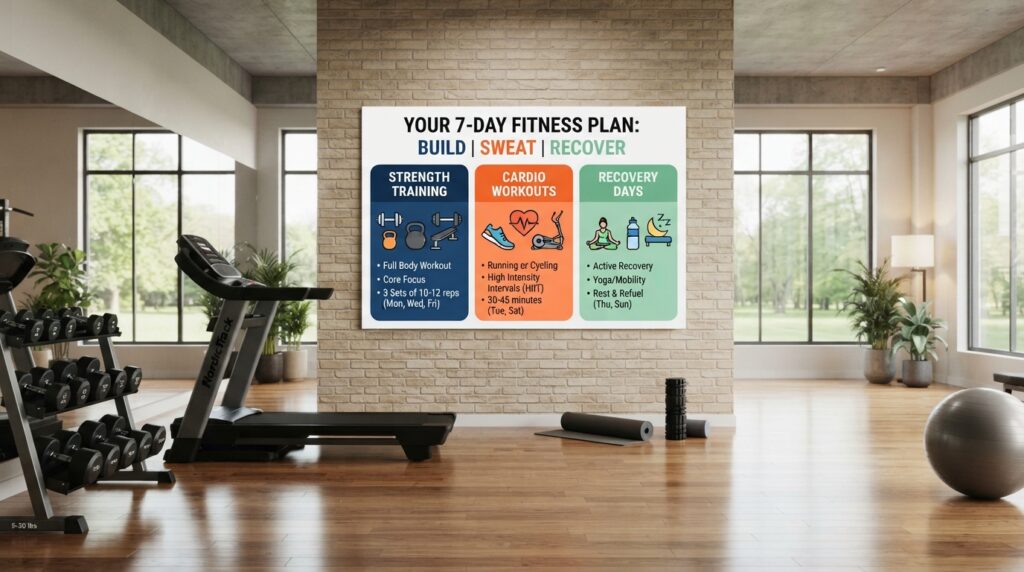
Three strength, cardio, and recovery exposures
This version spreads three kinds of activity across the week. It does not mean every session must be long or hard.
- Three strength exposures during the week.
- Three cardio exposures during the week.
- Three recovery or mobility exposures during the week.
Some exposures can be brief. A light mobility session can fit between more demanding workouts, and a walk can serve as cardio. We can adjust the plan when our schedule or energy changes.
Three workouts, movements, and sets
The other version means three workouts per week, three movements in each workout, and three sets per exercise. It offers a simple template, but three sets are not a required amount for every person or movement.
Leave 48 hours between sessions that train the same major muscle group. For example, after strength work for the legs on Monday, we can train them again on Wednesday. Upper-body work can fit on a different day.
The “mother of all exercises” is an informal nickname sometimes applied to the squat. It is not an official exercise category, and a squat does not train every fitness component. The major-muscle-group guideline offers a more useful standard than a catchy name.
Keep the structure only if it helps us train consistently and recover between sessions.
What Is the Best Time of Day to Exercise?
The best exercise time is the one we can maintain, with afternoon or early evening a possible fit for strength-focused work. Later sessions may support strength and high-intensity performance because body temperature tends to be higher later in the day.
Morning, afternoon, and evening can all work when they fit our daily life. Morning exercise may fit before other demands begin, while an afternoon session may suit a flexible schedule. We do not need to choose a time based on performance alone.
Evening workouts can also be practical, especially when that is our open time. Vigorous exercise close to bedtime may make it harder for the body to wind down. A gentler session may be a better late-day choice for some of us.
We can judge a schedule by how well it fits our sleep, energy, and other daily needs. If our workout time keeps getting pushed aside, a different time may be easier to protect.
If vigorous evening exercise interferes with winding down, finish it at least 2-3 hours before bed.
How Can We Make Exercise a Lasting Habit?
A routine is easier to keep when the first step is small enough to fit an ordinary day. Five minutes of exercise is a reasonable start for beginners, and we can build toward 10 or 15 minutes over time.
Consistency matters more than an ambitious first week. A health and fitness gym is optional: walking and body-weight activity can begin at home or outdoors. We can choose simple ways to make regular exercise part of our life.

- Start with five minutes, then build to 10 or 15 minutes.
- Schedule a workout on the calendar at a time we can protect.
- Invite a friend to walk or exercise with us for support.
- Add a short walking break during a long day of sitting.
- Notice our own progress instead of comparing workouts.
A small workout can be done without special gear. We might walk around the block or use body-weight moves in a clear space at home. If we miss a day, we can return to the routine without trying to make up every missed minute.
Friends can help us stay connected to a plan, while a calendar reminder makes the time easier to remember. We can also tie a session to something we already do, such as walking after lunch. The best plan is one we can repeat during an ordinary week.
Put one short activity session on our calendar and treat it as a realistic starting point.
What Exercises Help Older Adults Stay Strong and Steady?
For older adults, balance practice is worth including because falls are common and can cause serious injury. More than 14 million older adults in the United States fall each year, and falls lead injury and injury-related death among adults aged 65 and older. Balance practice has been shown to reduce fall risk by 24%.
Try balance exercises 3-5 times per week for about 15-20 minutes per session. A health professional can tailor exercise for older adults with balance concerns or major health conditions. Health and fitness programs may also be available through some plans, depending on eligibility and local networks.
Balance practice at home
Set up a clear area before practicing. Use a sturdy chair without wheels or a level countertop for support. These checks can reduce common hazards:
- Move rugs, cords, and shoes out of the practice area.
- Turn on enough lights to see the floor clearly.
- Keep a sturdy chair or countertop within reach.
- Choose a level spot with room to move safely.
Balance moves may include standing heel-to-toe or shifting weight while holding support. Begin with the support close by, and stop if a move feels unsafe.
Fitness benefits through Medicare plans
Original Medicare Parts A and B do not include SilverSneakers. Some Medicare Advantage plans include fitness benefits, sometimes at no extra cost to eligible members. SilverSneakers offers participating fitness-center access, online classes, on-demand workouts, exercise classes, and social events.
| Option | Participating in-person access | Online or on-demand access | Conditions or extra charges |
|---|---|---|---|
| Original Medicare Parts A and B | No SilverSneakers benefit | No SilverSneakers benefit | SilverSneakers not included |
| Eligible Medicare Advantage plans with SilverSneakers | Participating fitness centers; FLEX classes at non-traditional locations | Online classes and on-demand workouts | Plan eligibility applies; some plans include it at no extra cost |
| Eligible UnitedHealthcare Medicare Advantage plans with Renew Active | Participating gyms, equipment, classes, and group activities | Thousands of on-demand videos and live-streaming classes | No cost for eligible members; networks vary, and some amenities cost extra |
Renew Active is available at no cost to eligible members of many UnitedHealthcare Medicare Advantage plans. Some participating gyms charge extra for personal training, fee-based group classes, expanded access hours, or other amenities. Medicare Advantage plan benefits can vary by plan and local area.
Adapted movement for limited mobility
Chair-based curls, seated stretches, and calf raises can help us move while seated. Sit-to-stands train the legs when standing is safe, while supported balance work can be done near a stable surface. We can adjust range and speed to match our ability.
Clear the practice area and keep a sturdy support within reach before trying a balance exercise at home.
Clear the practice area and keep a sturdy support within reach before trying a balance exercise at home.
Conclusion
A stronger routine begins with movement we can return to, not a perfect plan. Health and fitness habits can grow from one activity that fits our current ability and schedule. We can build the routine over time as our confidence and energy allow.
Our first session does not need special equipment or a full hour. A short walk or a few simple strength moves can give us a clear place to begin. Choose one activity and schedule its first short session this week.