








In 2025, U.S. adults rated their average stress at 5 out of 10, while many also reported feeling isolated or left out. The same survey found that 54% often or sometimes felt isolated, 50% felt left out, and 50% lacked companionship. These experiences differ, and one person’s hard day may look nothing like another’s. Stress is a normal response to challenges, not a sign that we have failed. Work, relationships, and daily life can all bring pressure, yet small choices can help us feel more in control. We can start with a manageable step rather than trying to change everything at once. This guide offers practical ways to notice stress, respond in the moment, and find support when we need it. We can begin by noticing what is weighing on us today, without expecting one technique to solve everything.
Key Takeaways
- Stress is a normal response to life’s challenges.
- A short journal can help us spot recurring triggers.
- Slow breathing and grounding can help during a tense moment.
- Movement, regular meals, and sleep routines support daily well-being.
- Professional care is a reasonable choice when stress disrupts life.
What Does Stress Management Look Like in Daily Life?
In 2025, 62% of U.S. adults said societal division was a significant source of stress. Daily stress management begins with noticing what sets off our response, then choosing a useful next step. A clear pattern can make stress feel less mysterious.
Psychological tools for stress management include a brief journal of the trigger, our thoughts, feelings, and response. In the same survey, 76% said the nation’s future caused significant stress. Inaccurate or misleading information was a major stressor for 69%, up from 62% in 2024. The rise of artificial intelligence troubled 57%, up from 49% in 2024. Tracking one trigger at a time can show where we have control.
The APA’s 2025 survey findings also describe how societal division and loneliness affect many adults. Stress patterns can be temporary, recurring, or long-running. Acute stress is a short-term response to an immediate challenge. Episodic acute stress means repeated short-lived stress episodes tied to recurring triggers. Chronic stress continues over time, often with no quick end in sight.
| Stress pattern | What it looks like | A useful first move |
|---|---|---|
| Acute stress | An upcoming exam | Pause and identify the immediate concern |
| Episodic acute stress | Repeatedly overcommitting | Track the recurring trigger |
| Chronic stress | A long-term health or financial strain | Identify what is within our control |
A quick reset may help us face a stressful moment, but chronic stress may need more than a quick reset alone.
We can log what happened, what we thought, how we felt, and what we did next. A brief log of the trigger and our response can reveal a pattern that is easy to miss in the moment.
How Does Stress Affect the Body and Mental Health?
Stress can show up in our thoughts and feelings as well as in physical symptoms such as headaches, fatigue, and stomach problems. The body may also respond with insomnia, chest pain, or a racing heart. Stress affects people differently, and a symptom alone does not explain its cause.
The CDC says mental health is closely linked to physical health, and care for both can improve overall health. It lists social isolation, ongoing or chronic medical conditions, alcohol or drug use, and poor emotional well-being or coping skills as mental-health risk factors. Several risk factors can stack up, but a stressful symptom is not a diagnosis.
Physical signs and changes in mood
Stress may bring anxiety, low mood, or panic along with body changes. Among adults significantly stressed by societal division, 83% reported at least one physical symptom in the past month. That compares with 66% of adults who were not significantly stressed by it.
In the same groups, 42% reported nervousness or anxiety, compared with 29% of adults not significantly stressed. Fatigue affected 40%, compared with 29%; headaches affected 39%, compared with 29%. These figures describe groups, not a test for any one person.
When risks and symptoms deserve attention
About 23% of U.S. adults live with a mental-health condition, and 6% live with a serious condition that significantly interferes with daily activities. A mix of stress and other risks can affect how we feel, but no single factor proves that we have a condition.
New or severe chest pain needs prompt medical attention; we should not assume stress caused it. A racing heart or upset stomach can have other causes, too. Persistent symptoms that interfere with daily functioning deserve attention rather than dismissal as ordinary pressure.
What Can We Do to Calm Stress in the Moment?
For a quick reset, we can slow the breath and give our attention one simple sensory anchor. Gentle practice may help us feel steadier without adding another task to an already full day. Stop any technique that makes distress worse.
We can try this three-step practice while seated or standing:
- Plant both feet and notice their contact with the floor.
- Breathe in slowly through the nose, pause briefly, then exhale slowly through the mouth.
- Repeat until we feel steadier.
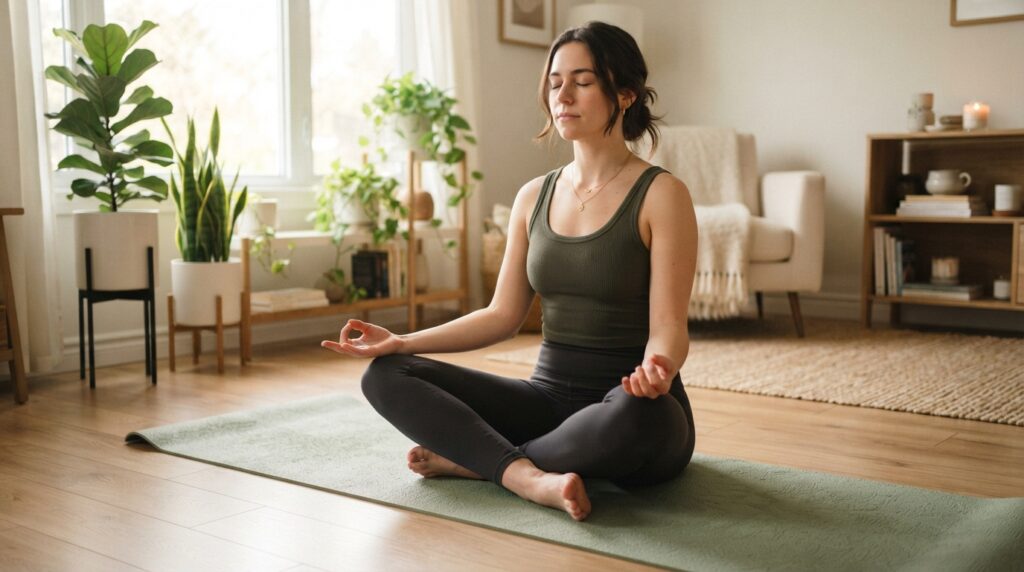
Slow the breath for a quick reset
Diaphragmatic breathing means breathing deeply from the belly. A 2019 review of three studies with 880 participants found early evidence that it may reduce stress. A review of 24 studies with 484 participants found that heart-rate-variability biofeedback helped reduce self-reported stress and anxiety.
That biofeedback uses information about changes in heart rhythm to guide practice. Results do not guarantee relief for every person. Stress-management tools can be simple, and a few minutes of practice may fit between work tasks.
Use mindfulness and sensory grounding
Mindfulness meditation focuses on the present, such as the flow of breath, while we notice thoughts without judging them. It needs no special equipment, and a few minutes a day is enough to practice. A 2019 review of 18 studies found moderately strong evidence that it improved sleep quality for people with sleep disturbances.
A 2020 review of 12 studies found beneficial effects of yoga on perceived stress in healthy adults. Meditation may help lower resting heart rate and blood pressure and improve sleep. A smooth stone, stress ball, or fidget item can offer a tactile anchor, but stress-management toys are not treatment.
Stress management training can teach repeatable relaxation skills, including mindfulness or biofeedback. We can keep that practice manageable, not turn it into another demand. If focusing on the breath makes us feel more distressed, we can stop and use a neutral sensory detail instead.
Which Daily Habits Help Reduce Stress Over Time?
A useful long-term routine is one we can repeat, not a punishing overhaul. Movement, steady meals, sleep, and supportive contact can help us manage stress and support health. Small steps count when they fit our real day.
Adults should aim for at least 150 minutes of moderate activity or 75 minutes of vigorous activity each week. We can mix the two, and short bouts still count. Three 10-minute walks can replace one 30-minute walk.

Build movement into the week
| Activity | Weekly target | Practical note |
|---|---|---|
| Moderate aerobic activity | At least 150 minutes | Build up gradually |
| Vigorous aerobic activity | At least 75 minutes | A mix with moderate activity is also an option |
| Strength training | All major muscle groups at least two times | Check with a healthcare professional first if health concerns or a long break apply |
Brisk walking, cycling, or dancing can add movement without special gear. Strength work can use body weight or simple weights. Our guide to everyday wellness routines offers more ideas for building steady habits.
Protect sleep and steady routines
Adults should aim for 7 or more hours of sleep each night. A regular bedtime routine and healthy regular meals can make days feel more predictable. Journaling and challenging unhelpful thoughts are other coping options.
The National Institute of Mental Health also recommends avoiding excess caffeine and reaching out to supportive friends or family. We can make time for a short check-in with a friend instead of waiting until stress feels unbearable.
Alcohol is not a reliable stress solution. If we drink, moderation means 2 drinks or less a day for men and 1 drink or less a day for women. For more ideas on manageable routines, see these practical whole-person wellness tips.
Movement, regular sleep, meals, and supportive contact can form a useful response when stress causes physical, emotional, or behavioral difficulties. If we have health concerns or have not exercised for some time, we should check with a healthcare professional before starting a new exercise plan.
How Can We Change Stressors and Build Stronger Support?
We can lower some pressure by changing a demand, changing our response, or accepting what is outside our control. Acceptance is not approval of harm, and it never means staying in an unsafe situation. We can use the four A’s: avoid, alter, accept, and adapt.
Avoiding may mean declining a nonessential task. Altering could mean asking for a deadline change. Accepting means naming what we cannot control, while adapting means finding a workable response. These choices can help us protect time and relationships.
Change demands or adjust our response
Five stress-management techniques we can try are:
- Set limits on nonessential demands.
- Make a clear request and stay willing to compromise.
- Reframe an unhelpful interpretation.
- Practice gratitude for specific things in our day.
- Make room for connection with supportive people.
For example, we might ask a coworker to share a task, then agree on a fair split. Gratitude works best as a real detail, such as a friend’s kind message, rather than a demand to feel positive.
Use connection and learning resources
Strong social connections and stable, positive relationships protect mental health. A short call, shared meal, or honest conversation can help us feel less alone. Support can come from family, a friend, or a trusted community group.
A useful stress management book depends on the approach we want. Full Catastrophe Living by Jon Kabat-Zinn covers body-scan meditation, gentle yoga, and sitting meditation. Burnout: The Secret to Unlocking the Stress Cycle by Emily Nagoski and Amelia Nagoski offers strategies such as movement, creative expression, and affection.
The Upside of Stress by Kelly McGonigal looks at reframing the stress response as a possible source of energy, growth, and connection. Harvard University’s online stress management course has 90 lessons about the relaxation response and resilience. Online resources for stress management can offer guided practice and structured learning.
Yoga, meditation, and prayer can help produce the relaxation response. Before adding a new practice or course, choose one that fits our time, access, and personal values.
When Should We Seek Professional Help for Stress?
Stress deserves professional support when symptoms repeatedly disrupt daily life or keep us avoiding normal activities. Symptoms that feel constantly present can also signal that self-guided coping is not enough. We do not need to wait until a crisis to ask for care.
A healthcare professional can assess symptoms and discuss options, including cognitive behavioral therapy. Psychotherapy and medication are the two main treatments for anxiety, and many people benefit from a combination. Persistent mental-health symptoms that interfere with daily functioning deserve professional attention.
Cognitive behavioral therapy can help us change how we respond to life stressors. A clinician can also consider health problems or other factors that may affect our feelings and coping. We can describe what has changed, when it began, and how it affects work or relationships.
We do not need a confirmed diagnosis to reach out during emotional distress or when we need someone to talk with.
The main anxiety treatment options include psychotherapy and medication, alone or together. A crisis need does not require certainty about a diagnosis. The 988 Suicide & Crisis Lifeline is free, confidential, and open 24/7/365 by call, text, or chat for emotional distress and related concerns, including alcohol or drug use.
If we or someone with us may be in immediate danger, contact emergency services; for emotional distress or a need to talk, call or text 988.
Conclusion
We do not have to change every part of our life to take one useful step toward feeling steadier. A small, repeatable choice can help us respond to pressure with more care and a little more control. We can also ask for support without treating it as a failure.
Some days, the right next step is simple; on others, we may need help from someone trained to support mental health. Either choice can be part of caring for ourselves. Choose one action for today, such as taking a short walk, writing down a stress trigger, or contacting someone we trust, and decide when we will do it.