



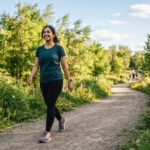
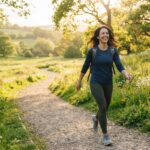

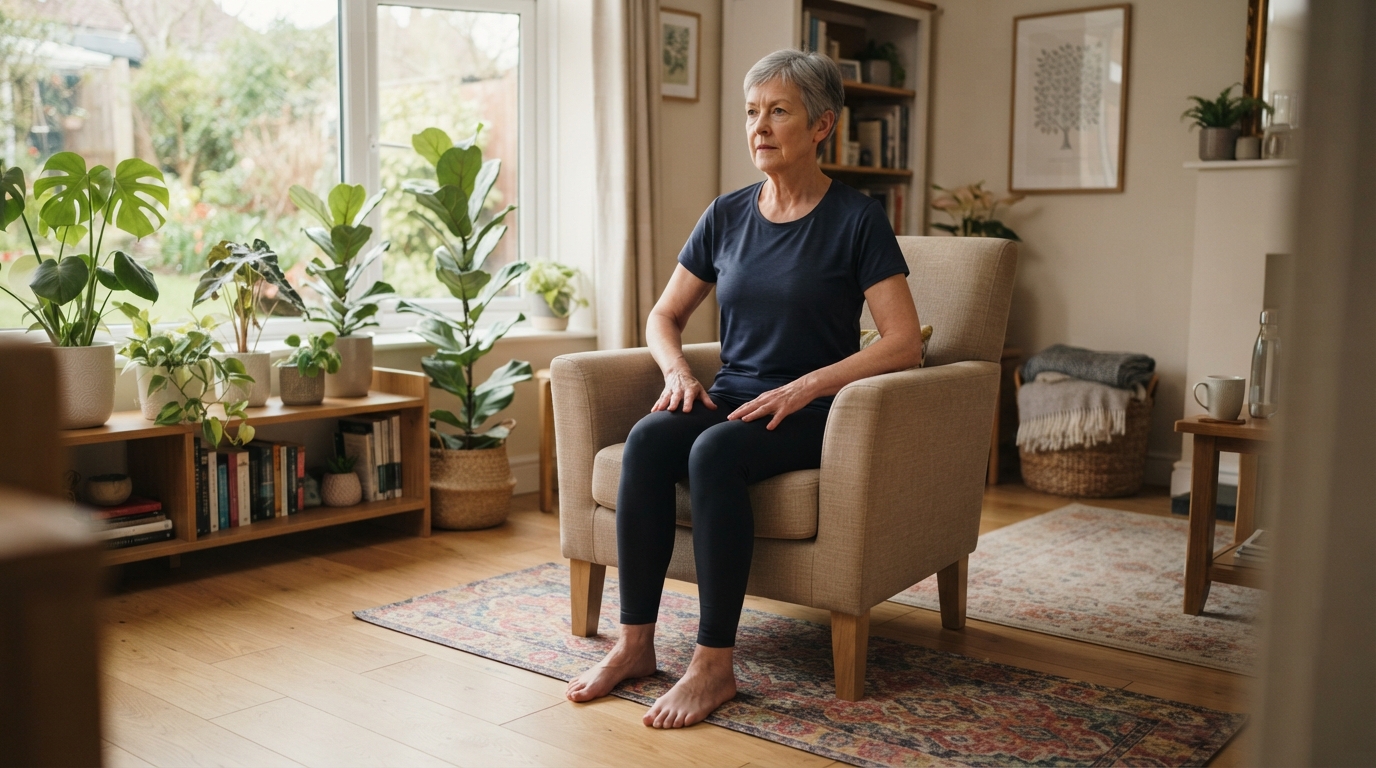
Physical fitness can improve with just ten extra minutes of daily movement, a change that can make a difference. We do not need a perfect plan, a gym membership, or a long workout to begin. A short walk, a chair-based movement, or a few manageable strength exercises can give us a useful starting point.
Our bodies and schedules differ, so the right first step will not look the same for everyone. We can choose an activity that feels comfortable and fits the time and space we have. Then we can repeat it, notice how it feels, and adjust when our ability or routine changes.
Regular practice matters more than doing every session perfectly. Some days, we may have time for a longer effort; other days, a few minutes may be realistic. Returning to movement helps us build capacity in a way we can keep up.
This guide offers a practical path toward better strength, stamina, and everyday function. We can start small, choose a pace that suits us, and build from there without turning exercise into an all-or-nothing task.
Key Takeaways
- Start with an activity we can manage and repeat.
- Use walking, home exercises, or other movement that fits our life.
- Build strength and stamina through regular practice, not perfect workouts.
- Adjust our activity to our ability, health, and schedule.
- Choose one activity we can comfortably repeat this week.
A useful first goal is to choose one activity we can comfortably repeat this week.
What Does Physical Fitness Help Us Do?
Physical fitness helps us do everyday tasks with more strength and stamina, while regular movement supports health and well-being. Physical activity is any bodily movement that uses energy, including household and work tasks; exercise is physical activity we do intentionally. Physical fitness means our ability to handle daily tasks with strength and endurance while managing fatigue.
That ability can make ordinary moments easier, from carrying laundry to walking across a parking lot. It is about useful function, not looks or athletic skill. Regular movement can also support sleep, mood, and the way we feel during the day.
Physical activity includes movement at work, at home, during travel, and in our free time. The World Health Organization describes these broad forms in its physical activity overview. Exercise is the part we choose to do on purpose, such as a planned walk or strength session.
Some benefits can show up soon after we move. A walk may help us feel more alert, and steady activity can support better sleep and mood. Over time, regular movement can lower the risk of heart disease, stroke, and type 2 diabetes.
Physical activity also lowers risk for at least eight types of cancer. In the United States, the CDC estimates that 110,000 deaths each year among adults ages 40 and older could be prevented if they increased moderate-to-vigorous activity. Even ten additional minutes a day could make a difference for health.
We can count household and work tasks as movement, even when they do not feel like a workout. That wider view can help us notice chances to move during a busy day. It also makes a routine easier to fit around real life.
Even a small increase in daily movement is a worthwhile place to begin.
Our aim is to build more capacity for the tasks that matter to us. We might want to climb stairs with less effort, keep up on a walk, or feel steadier while doing chores.
More movement is not a test of willpower, and a difficult day does not erase earlier effort. We can begin with an amount that fits our current ability and add time as it feels manageable. Even a small increase in daily movement is a worthwhile place to begin.
What Are the Main Components of Physical Fitness?
A well-rounded view of fitness includes five components, not just how fast we can run or how much weight we can lift. Each component describes a different ability, and the examples show how those abilities connect to daily life. We can use the five components as a checklist rather than a scorecard.
Cardiorespiratory fitness describes how well our heart and lungs support sustained effort. Muscular strength is the force our muscles can produce, while muscular endurance is their ability to repeat effort. Body composition describes the relative amounts of muscle, bone, water, and fat in the body.
Flexibility refers to how freely a joint can move. These components do not work in isolation: carrying groceries uses strength, and repeated chair rises call on endurance. One activity can support more than one part of fitness.
| Component | What it describes | One example | Everyday relevance |
|---|---|---|---|
| Cardiorespiratory fitness | Sustained effort | Brisk walking | Walking for longer |
| Muscular strength | Force | Carrying groceries | Lifting a full bag |
| Muscular endurance | Repeated effort | Repeated chair rises | Standing up more than once |
| Body composition | Body makeup | Relative muscle, bone, water, and fat | Understanding body makeup |
| Flexibility | Joint movement | Reaching overhead | Getting items from a shelf |
For planning, it can help to group activities as aerobic, muscle-strengthening, balance, or flexibility work. These are practical activity categories, not a second list of body parts. Walking is mainly aerobic, while some other activities combine strength, balance, and flexibility.
The overlap gives us room to choose movement we enjoy. A dance class can raise our breathing rate while asking us to coordinate steps. Yoga may involve strength and joint movement, too.
Our goals can guide which areas we focus on first. If climbing stairs feels hard, sustained effort may be a useful area to build. If standing from a low chair takes effort, we may value force and repeated effort.
We do not need to measure every part of our body to make a plan. The components simply help us spot abilities we want to build and activities that may fit. We can use the five components as a checklist, not as a demand to measure every part of our body.
Which Activities Build Aerobic Stamina?
A brisk walk is a practical way to build aerobic stamina because it raises our breathing and heart rate while using large muscles. Brisk means a pace that asks us to work but still lets us stay in control. Brisk walking for 30 minutes a day, 5 days a week meets the current physical-activity guideline.
Walking does not require special equipment, and we can choose a route that matches our comfort. Distance varies with pace, stride, and terrain, so time gives us a clearer target than miles. We can split a walk into shorter periods if that suits our day.
Walking and other steady cardio
Steady aerobic activities work large muscle groups and keep us moving for a sustained period. We can pick an option that feels pleasant, accessible, and safe for our current ability. Five practical choices are:
- Walking at a pace that feels purposeful.
- Cycling outdoors or on a stationary bike.
- Swimming or moving through water.
- Dancing to music we enjoy.
- Pushing a lawnmower or doing similar yard work.
These examples answer what physical fitness activities can look like without requiring gym equipment. A familiar neighborhood walk may suit us better than a formal class, while someone else may prefer dancing indoors. The best option is one we can return to with some regularity.
Use the talk test to gauge effort
The talk test helps us judge intensity by noticing how speech feels during activity. At a moderate pace, we can talk, though singing may be difficult. During vigorous effort, we can say only a few words before needing a breath.
We can begin at a comfortable pace and build duration or intensity gradually. If we have been inactive, a short walk may be enough for the first session. As that feels easier, we can add a few minutes or pick up the pace slightly.
A route with hills may feel harder than a flat sidewalk, even when the time is the same. Weather and surface can change how a walk feels, too. We can use breathing and speech rather than distance alone to check our effort.
Moving at a pace that lets us speak in short sentences gives us room to keep going without rushing. If conversation becomes difficult, slow down until the effort feels manageable again.
How Do We Build Strength Safely?
We can build strength with body weight, bands, free weights, or machines, as long as the muscles work against a manageable resistance. Resistance is the force our muscles push or pull against during an exercise. Good form and steady breathing matter more than rushing to heavier weights.
Strength training can improve muscle mass, strength, and physical function. An umbrella review of 44 systematic reviews found these gains in healthy adults who did resistance training, compared with no exercise. We can start without lifting experience and add challenge over time.
Start with body weight or resistance bands
Body-weight exercises use our own weight for resistance. A chair squat can begin with a shallow range of motion, while wall pushups let us adjust how much body weight we support. Resistance-band rows work the back and arms, with band tension changing the challenge.
We can move slowly enough to stay in control and breathe through each repetition. For example, we can breathe out as we push up from a chair and breathe in as we lower. A set should feel challenging near its end, not painful or rushed.
Progress with weights and machines
Dumbbells and weight machines offer other ways to train. A dumbbell press lets us move each arm freely, while a chest press machine guides the path. We can progress by making a small change to resistance, repetitions, or sets when our current work feels controlled.
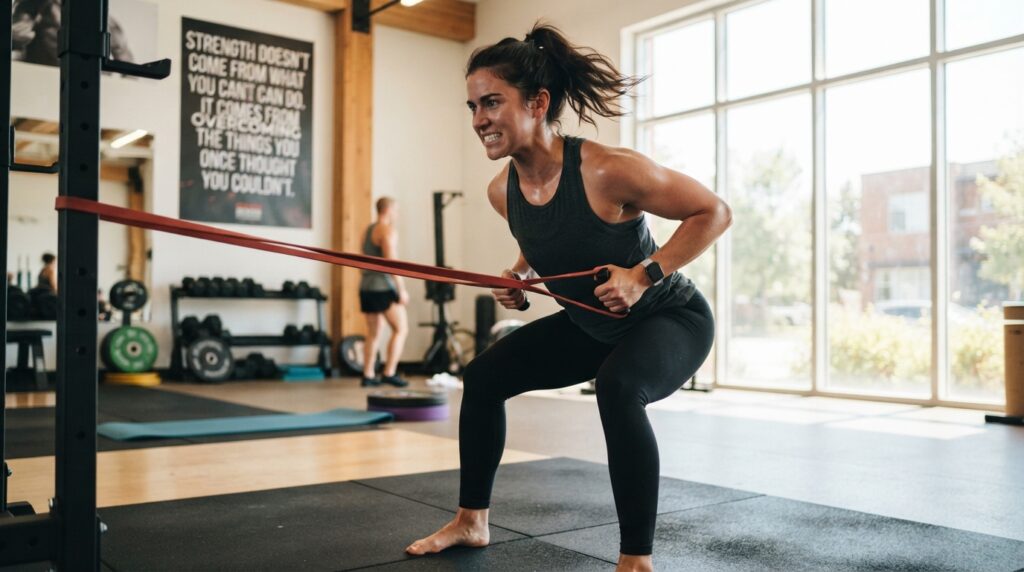
| Method | Example | Progression option | Useful beginner feature |
|---|---|---|---|
| Body weight | Chair squat | Range of motion or repetitions | No equipment |
| Resistance band | Seated row | Band tension | Adjustable resistance |
| Weights or machine | Dumbbell press or chest press | Load or repetitions | Guided resistance |
One set of an exercise with enough resistance to tire the muscles after about 12-15 repetitions can provide health and fitness benefits. Sets affect gains in muscle mass and strength, while load and weekly frequency also affect strength gains. We do not need to chase a heavy weight to make training useful.
We can set up a movement so the effort feels steady from the first repetition to the last. If our form changes or we hold our breath, the challenge may be too high. Increase only one training challenge at a time so we can tell how our body responds.
Why Add Balance and Flexibility?
Balance and flexibility help us control movement and reach comfortably, skills that matter beyond a workout. Balance means staying stable while still or moving, and flexibility is a joint’s range of motion. Any balance practice that feels uncertain belongs beside a stable support.
We use balance when we turn, step around an obstacle, or stand while getting dressed. A simple practice is standing on one foot beside a counter or sturdy chair. Heel-to-toe walking and tai chi offer other ways to work on stability.
Balance practice can fit into the week about three times. It does not need to be long or complex; a few careful steps along a clear path may be enough to begin. Tai chi can also combine balance with other kinds of movement.
Gentle stretching can help us maintain joint movement. We should feel a stretch, not pain, and avoid forcing a joint farther than it wants to go. Slow, calm movement makes it easier to notice how our body responds.
Yoga can combine flexibility, balance, and strength elements, though classes can vary in pace and difficulty. We can look for a beginner session or change a pose to suit our range of motion. An activity should feel like a reasonable challenge, not a test.
If we feel unsteady, a wall, stable chair, or helper can make practice feel safer. We can use the support for the full movement rather than waiting until we wobble. Keep a sturdy support within reach whenever a balance drill feels uncertain.
How Can We Test Fitness and Track Progress?
A fitness test is useful when it tells us about a specific ability we can work on, not when we treat one score as our whole health. A test can assess selected skills, but results depend on the test and are not a diagnosis. We learn more by repeating the same personal measure under similar conditions.
The Senior Fitness Test assesses strength, aerobic endurance, flexibility, and dynamic balance. Dynamic balance is the ability to stay stable while moving. Its results can help describe function, but they do not capture every part of health or fitness.
| Senior Fitness Test area | Ability assessed | Everyday example |
|---|---|---|
| Strength | Force production | Rising from a chair |
| Aerobic endurance | Sustained activity | Walking |
| Flexibility | Joint range | Reaching |
| Dynamic balance | Stability while moving | Changing direction |
A review of Senior Fitness Test benchmarks included seven studies from five countries, with participants ages 60 to 103. Fitness percentiles declined with advancing age. No study reported the complete eight-component test battery, so those benchmarks do not represent every test area.
Benchmarks vary with age, and test scores can also reflect ability on that day. We do not need to compare ourselves with someone of a different age or ability. A score is one clue, not a final judgment about what we can do.
A repeatable personal check can be simpler than a formal assessment. We might note how long we can walk comfortably or how many controlled chair rises feel manageable. We can write down the date and conditions, such as the same route or chair.
Small changes can be useful even when a number barely shifts. A walk that feels easier, or a chair rise that needs less effort, tells us something practical. Repeat the same simple check under similar conditions so we can compare our own progress fairly.
How Do We Make a Weekly Routine That Lasts?
The routine most likely to last is one that fits our schedule and includes activities we are willing to repeat. Manageable periods of activity can add up across a day or week. Some moderate-to-vigorous activity can benefit health even below the weekly target.
We can spread movement across the week instead of setting aside one long block. A routine might pair walks with strength sessions and brief balance practice. We can choose home, a gym, or the outdoors based on access, equipment, schedule, and comfort.
Before joining a local facility, we can check its hours and amenities. A nearby gym may offer machines and classes, while a community space might have a walking track. The right place is the one we can reach and use without adding stress to the week.
Five simple habits can help a plan fit real life:
- Practice regularly, even when each session is brief.
- Increase activity gradually as our body adapts.
- Add a manageable challenge when current work feels easier.
- Vary activities to keep the routine interesting.
- Keep showing up for short sessions when time is tight.
These habits leave room for busy days and changing energy. If we miss a planned session, we can return at the next time that works instead of trying to make up everything at once. A small routine can still have a place in a full week.
Three hundred minutes or more of moderate activity each week can offer additional benefits. That higher level is not a required starting point. We can begin with the time we have and build toward more when it suits our health and schedule.
We can make the plan visible by putting sessions on a calendar or pairing them with a regular task. A walk after lunch may be easier to remember than an open-ended plan to move later. Put the next activity on the calendar at a time we can realistically protect.
How Can Older Adults Adapt Activity and Prevent Falls?
Adults 65 and older should aim for at least 150 minutes of moderate aerobic activity each week, plus muscle strengthening and multicomponent activity. Multicomponent activity combines balance, aerobic, and muscle-strengthening activity. Older adults can adapt the plan to their abilities and health conditions.
Adults who cannot reach 150 minutes because of chronic conditions should be as active as their abilities and conditions allow. Some activity is better than none. Activity below the weekly target can still benefit sleep, blood pressure, chronic disease risk, and functional ability.
Match activity to ability and health
In 2024, the guidance for adults ages 65 and older called for muscle-strengthening activity on two or more days each week. It also included multicomponent activity alongside aerobic movement. Brisk walking for 30 minutes a day, 5 days a week meets the aerobic time target.
Fewer than 15% of US adults ages 65 and older meet the Physical Activity Guidelines, while over 37% do no leisure-time physical activity. Those figures point to room for many people to begin with an amount they can manage. A short walk or gentle movement at home can be a real start.
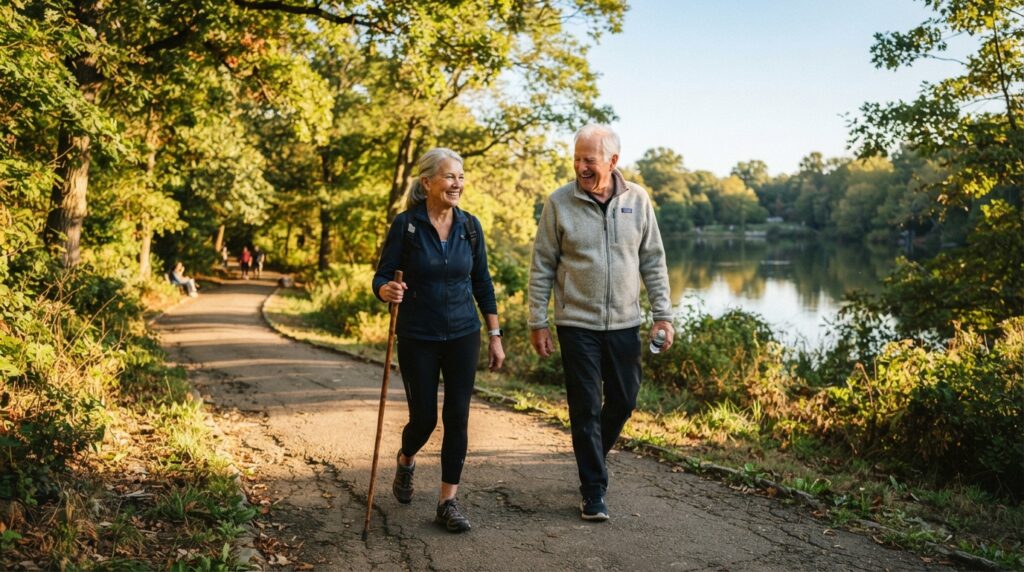
Health conditions can shape the type and pace of activity that feels right. We can use the way we feel during and after a session to guide adjustments. When a chronic condition limits movement, the goal is to work within our abilities rather than abandon activity.
Make fall prevention part of the plan
The USPSTF recommends exercise interventions for community-dwelling adults ages 65 and older who have an increased risk of falls. The recommendation is Grade B. Falls are the leading cause of injury-related illness and death among older US adults; fall-related injuries caused 38,742 deaths in 2021.
A clinician can assess a few signs that may point to increased fall risk:
- Previous falls.
- Problems with physical function.
- Limited mobility.
Fall-prevention programs most often include gait, balance, and functional training. They may also include strength and resistance work, flexibility, and endurance training. A program can be shaped around which movements feel difficult and the risks a person faces.
The USPSTF recommends individualizing multifactorial interventions because routinely offering them has a small overall net benefit. That means a plan should fit the person’s risks and needs, rather than adding every possible measure to everyone’s routine.
If a fall or mobility problem has changed what feels safe, ask a clinician to help tailor an exercise plan.
When we notice a new fear of walking, trouble turning, or repeated falls, that change matters. A tailored plan can focus on safer movement and the abilities a person wants to regain. If a fall or mobility problem has changed what feels safe, ask a clinician to help tailor an exercise plan.
What Supports Recovery, Nutrition, and Muscle Growth?
Muscle growth comes from repeated resistance training and recovery, with adequate nutrition supporting the process rather than replacing it. Rest and sleep give the body time to recover between training sessions. No protein drink builds muscle quickly by itself.
Resistance exercise is the main training signal for muscle growth. Food and rest help support the work, but a supplement cannot take the place of training. We can think of nutrition as part of the process, not a shortcut.
Across 74 randomized controlled trials, additional protein during resistance exercise led to small extra gains in lean body mass. For adults 65 and older doing resistance exercise, the benefit was significant at daily protein intakes of 1.2-1.59 grams per kilogram of body weight.
That intake range describes the exercise context in the review; it is not a personal prescription. Needs can differ with health, diet, and other factors. A protein drink may be a convenient way to meet dietary needs, but no drink causes fast muscle growth on its own.
A 2024 review of community-dwelling older adults with sarcopenia found that protein supplements combined with resistance exercise increased muscle mass and strength. Sarcopenia means age-related loss of muscle. The review included seven randomized controlled trials and one quasi-experimental study, with 854 participants ages 60 and older.
The interventions lasted 10 to 24 weeks, so the results reflect a period of combined training and nutrition. They do not show that a drink alone can build muscle. Regular training, enough food, and recovery all play different roles.
Older adults with muscle loss, medical conditions, or dietary concerns can ask a clinician or registered dietitian for individual advice. That can help us account for health needs or limits that affect food choices. Choose food or a protein drink to meet a real nutrition need, not as a shortcut around training and rest.
Conclusion
We can build a stronger, more capable body through small activities that become a regular part of life. A beginner does not need a perfect routine to start, and one missed session does not undo earlier effort. We can choose movement that suits our current ability and make room for it in an ordinary week.
Steady activity can help us handle daily tasks with more ease. Our first goal can be modest enough to feel possible and clear enough to put on a calendar. That gives us a real next step, not another plan we hope to begin someday.
We can adjust our routine as our time, health, and confidence change. The important thing is to start at a manageable level and return when the next chance comes. Pick one activity, set a realistic time for it this week and begin at a level that feels manageable.